Thursday, 28 March 2019

The Arithmetic Materials ~ Golden Beads ~ Operations ~ Addition

~ This post is the third in a series about the Golden Bead Material. ~

Once a child is able to form and read complex numbers with the Large Number Cards and Golden Bead Material, operations are introduced.  This post will focus on addition, both static (no carrying over) and dynamic (carrying over).

Static Addition

Gather three children for this activity.  Two children are asked to set out the Small Number Cards. 


One child is asked to set out the Large Number Cards.  This child will be the banker.


(For this post, two numbers will be added together.)  The teacher selects four different Small Number Cards for the children.  These are placed on the children's trays.  The children are asked to go to the banker and ask for the amount of Golden Beads that correspond to the numbers on their tray.They are asked to meet the teacher back at the mat.

1,425

2,361

When the children return to the mat, each child is asked to verify the amount of beads on their tray.  These beads are then placed on the mat.  The child slides his/her number cards together and is asked to read the numbers.  The number cards are placed at the top right corner of the mat.


1,425 + 2,361 ~  Symbol and Quantity

The children are asked to put the Golden Beads together and count them.  This begins with the units.  Once the number of units is known, the child goes to the banker to get the Large Number Card that corresponds to this amount.   This is done for all the categories - units, tens, hundreds, thousands.

Putting the Beads Together

Slide the Large Number Cards together to get the total amount of beads brought to the mat.  Place it under the Small Number Cards in the top right corner of the mat.  "When you add small quantities to get a larger one we call it addition."  Note the two numbers added together (the addends) are represented with the Small Number Cards.  The answer (the sum) is larger and is represented with the Large Number Cards.

The Sum

Dynamic Addition

Once the children have had practice with static addition, dynamic addition is introduced.  The lesson is similar to the introduction of static addition.  The difference occurs when the children put the Golden Beads together.


Number cards are selected.  Quantities are retrieved from the banker and brought back to the mat. 

2,136

3,425


The quantities are placed on the mat.  The Small Number Cards are slid together. 


Small number cards and quantities ready to be added together.


In this example, the carrying over occurs in the units category (6 + 5 = 11).  Ten is a magic number.  When we have ten of one category, we must exchange for the next category.  In this case, we exchange ten units for one ten.  We are left with one unit.


The child has made a ten with the units.  The ten individual units are exchanged at the bank for a ten bar.  One unit is left.


The children continue to put the categories together and retrieve the corresponding Large Number Cards.


The Large Number Cards are slid together to get the total amount of beads brought to the mat.


"When we add small quantities together to get a larger one, what did we do?"  The children say "Addition."

The purpose of these activities is to give the children an impression of the nature of addition.  It is also to show how numbers can carry from one hierarchy to the next.

Wednesday, 27 February 2019

The Arithmetic Materials ~ Golden Beads ~ Formation of Complex Numbers

~ This post is the second in a series about the Golden Bead Material. ~

Once a child has been introduced to the Decimal System material, they will begin to use it to form complex numbers.  The purpose of this exercise is to make the child aware of the hierarchy of the decimal system.  The digits 1 to 9 remain the same.  It is the place the digit occupies in the complex number - units, tens, hundreds, thousands -  which gives it its meaning.  It is also to show that zero is a place holder for an empty category.  (In the number 2, 307, zero shows us that one of the categories, the tens, are missing.)  Through this material, the child is given practice in the interpretation of complex numbers and is introduced to the proper wording.

The child is asked to set out the Golden Bead Material on one mat and the Large Number Cards on another mat. 
 
Setting Out the Large Number Cards


Setting Out The Limited Bead Material

(r to l) Units, Tens, Hundreds, Thousand

For the first exercise, the teacher sits at the mat with the number cards and places one card from the units category on a child's tray.  The child is asked to go to the mat with the Golden Bead Material and get this amount.  When the child returns, the child is asked to count the beads to confirm the amount.


When the child is familiar with the units, a card from the next category is added.  Now the child has a card from the units category and another card from the tens category.  Again, the child is asked to go to the mat with the Golden Bead Material and get this amount.  When the child returns, the child is asked to count both sets of beads aloud, first the units and next the tens.


2 Units, 6 Tens

The teacher will then “do something special with the cards” and place the units card face up on top of the tens card (the units card is not placed on the zero of the tens card at this point). 

The units card is placed on top of the tens card.

While the child is watching, the teacher gently pushes the edge of the bottom card against the palm of the hand so that the units card slides down over the zero on the tens card.

The teacher slides the unit card down over the zero on the tens card.

The teacher will ask ‘What did you bring?’  The child will say ‘two units’ and ‘six tens’.  The teacher says “We call six tens and two units, ‘sixty-two’”.  This work continues with new numbers.  Once the child has mastered two categories (units and tens) another category is added.  After the first presentation, the child may slide the cards.

Sixty-two

The formation and reading of complex numbers (example - 4,239) leads to work with the operations (addition, subtraction, multiplication and division).  A future blog post will discuss operations with the Golden Bead Material.

This material is used extensively in the Montessori preschool (casa) and early elementary.  It is introduced to children at 4 - 4 1/2 years of age.

Friday, 15 February 2019

A Chinese New Year Presentation

While the weather in February can be very dreary in our little corner of the world, our school days have been very cheery!  With Chinese New Year and Valentine's Day occurring close to one another, there was much to celebrate.  In the past, the teachers have given a presentation to introduce Chinese New Year to the children.  This year we were absolutely delighted by a presentation given by two of our students, five year old M. and her three year old sister G..

M. began the presentation by talking about this year's animal, the pig. 


Five Year Old M. (l) and Three Year Old G. (r)

She spoke of her family's traditions.  On the eve of Chinese New Year, her family had a big reunion dinner.  Everyone wore traditional clothing, with red being the luckiest colour.  Some of our students also wore traditional clothing to school.

Traditional Chinese Clothing

Traditional Chinese Clothing

The reunion dinner consisted of many tasty foods - fish, dumplings, noodles, spring rolls and fruit.  M. and G. introduced their classmates to Chinese New Year symbols of luck.  They handed out Chinese New Year cards and explained the symbols found on them, such as bamboo and dragons.


Five year old A. joined the presentation and explained the animals of the Chinese Zodiac.  She brought in some zodiac place mats for everyone to take home.


A. and the Chinese Zodiac Place Mats

The children were eager to know which animal they were.  We used the place mats to create an activity for the classrooms.

Setting Out the Chinese Zodiac Animals


We also had a chopstick activity on the shelves.


At the end of the presentation, M. and G. took questions from the audience.


Answering Questions

The children were interested in the Chinese New Year items that were set out on the table.


Everyone took home a lucky money envelope. 

Lucky Money Envelopes

Thank you M. and G. for a lovely presentation!


Note:  Presentations such as these occur often in a Montessori environment.  Those unfamiliar with the Montessori Method of education may be wondering how it is possible for young children to display such self-confidence and respect for one another.  Put simply, the Montessori environment with the Montessori materials and simple rules that everyone must follow, is very effective at helping children develop confidence in their abilities and the realization that they share the world and must respect everyone's rights.  While most people associate Montessori with strong academic skills, it is the more subtle lessons learned ~ such as respect for one another, perseverance and self-regulation ~ that provide Montessori students with the tools needed to be successful in the world.


Wishing everyone much good luck in the year of the pig!


Wednesday, 23 January 2019

The Arithmetic Materials ~ The Golden Beads ~ An Introduction to the Decimal System


Of all the materials that Maria Montessori created, perhaps the most brilliant of these is the Decimal System material also known as the Golden Beads.  Non-Montessori educational companies have tried to copy this material, yet it is never quite as beautiful as the original.

The Decimal System material consists of single golden unit beads, golden ten-bead bars (ten-bars), golden-hundred squares (hundred-square) and golden thousand-bead cubes (thousand-cube).  The ten-bars are ten individual units strung together on a wire.  The hundred squares are ten ten-bars wired together to form a square.  The thousand cubes are ten hundred-squares wired together to form a cube.

The Golden Bead Material - Introduction Tray

In the first presentation, the child is introduced to this material.  A unit bead is removed from the tray and introduced as one unit.  The child is invited to hold and examine it.

Examining the Unit Bead


A ten-bar is removed from the tray and introduced as one ten.  The child is told that it is made of ten units and invited to hold each bead and count it.  Ten units make one ten.


Examining the Ten-Bar

The hundred-square is removed from the tray and introduced as one hundred.  The child is invited to hold and examine it.  The child is told that the hundred square is made of ten-bars.  The child then takes a ten-bar and counts to see how many tens make one hundred.  Ten tens make one hundred.


Examining the Hundred Square

The thousand-cube is removed from the tray and introduced as one thousand.  The child is invited to hold and examine it.  The child is told that the thousand cube is made of hundred squares.  The child then takes a hundred-square and counts to see how many hundreds make one thousand.  Ten hundreds make one thousand.


Examining the Thousand Cube

The purpose of the Decimal System material is to make the child familiar with place value and the names of the decimal categories (units, tens, hundreds and thousands) and their relative proportions.  It illustrates that each decimal category is ten times the previous category. 

On another day, the child is shown where the Golden Bead Material is kept in the classroom.  The child is asked to bring various quantities of the material on a tray.

7 Units
4 Tens
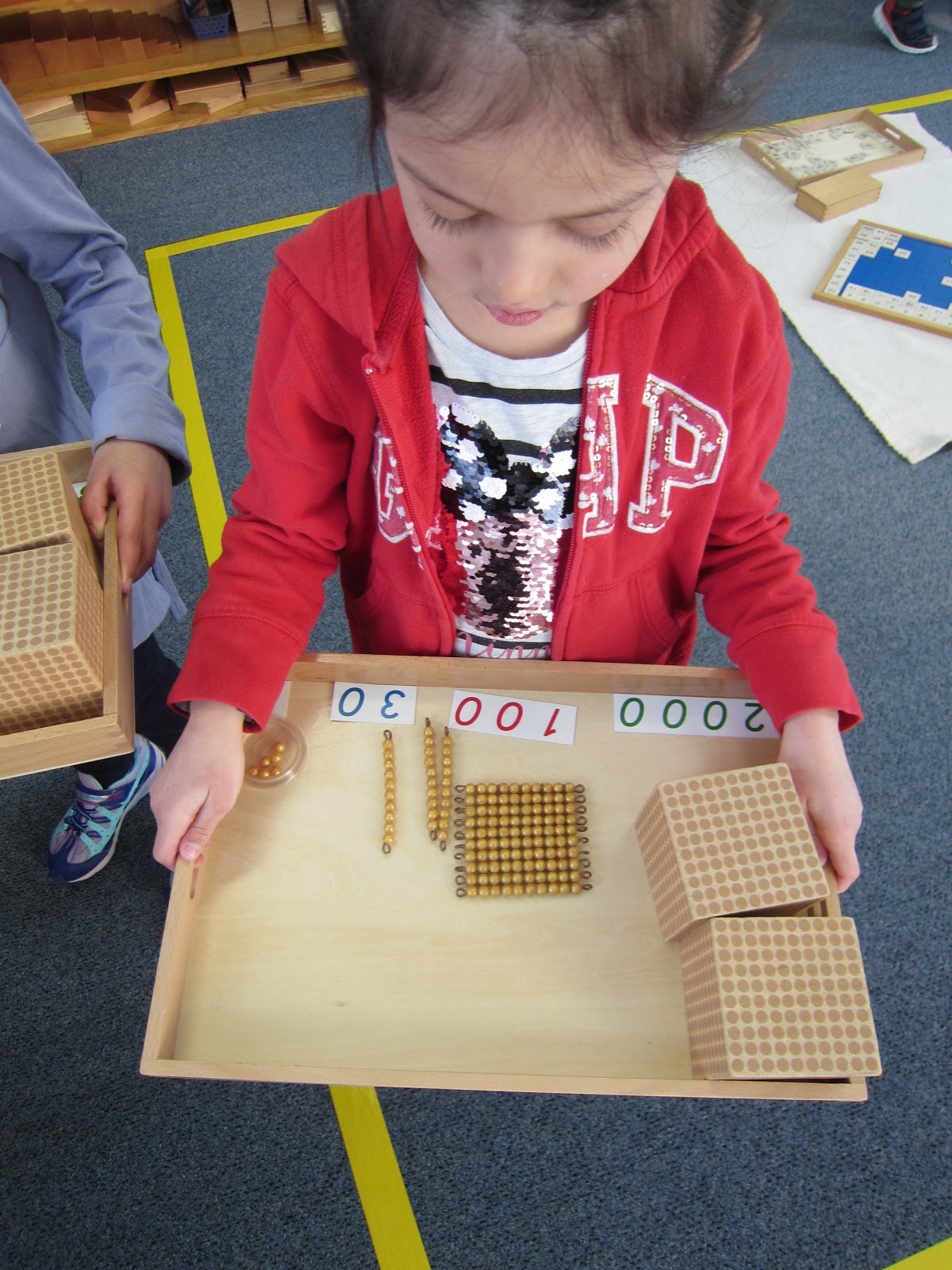
Units, Tens and Hundreds

Once the child is familiar with the quantities, symbols are introduced for the decimal categories (number cards for the decimal categories units, tens, hundreds and thousands).


The Golden Bead Material - Symbol Introduction Tray


When the child is familiar with the symbols, they are matched with their quantities.


Matching Symbol and Quantity

These introductory lessons lead to the formation and reading of complex numbers (example - 3,246 with number cards and beads) and work with the operations (addition, subtraction, multiplication and division).  Further blog posts will discuss this progression.

This material is used extensively in the Montessori pre-school (casa) and early elementary.  It is introduced to children at 4 - 4 1/2 years of age.