Showing posts with label Math Materials. Show all posts

Wednesday, 16 February 2022

Let's Celebrate! ~ Celebrations in the Montessori Classroom

There are many different opinions on whether or not to celebrate holidays in the Montessori classroom.  Some schools choose not to celebrate anything except the birthdays of their students.  Whether we choose to celebrate holidays in the classroom or not, they still exist in the world.  In my nearly 30 years of teaching, I have always celebrated holidays with the children in my classrooms and at our little yellow school.   The holidays we have celebrated are inclusive of the cultures and religions of the children and families in our school community.   

At our little yellow school, the celebration of a holiday is not highlighted on one day with no connection to anything else.  Rather, activities are introduced gradually across the curriculum in the weeks leading up to the celebration.  The following are some examples.

The Practical Life shelves reflect the colours and theme of the celebration.

Valentine Tonging Work

Lunar New Year Tonging with Chopsticks

Spooning Pumpkin Seed 'Ghosts"


Opening Easter Eggs with Surprises!

Preparing Pumpkin Seeds for Roasting

Peg Christmas Tree

The Language Shelves and Circle Time incorporate stories, poems and songs.

Melting Like a Menorah Candle

A Halloween Rhyme

Learning About Diwali

 
A Valentine Book

Playing Tombola (An Italian Christmas Eve Tradition)

Spinning a Dreidel

Decorating the Christmas Tree

Arithmetic activities incorporate seasonal items such as seasonal counters.


Halloween Ghost Counters

Valentine Heart Estimating Activity

Art activities change to reflect the holiday.

Valentine Hearts

Lunar New Year Tigers
 

Reindeer Craft

Diwali Lamps


The Culture Shelves have items and photos associated with the holiday.


Lunar New Year Items


Hanukkah Items

A Visit from Santa Claus


A Visit from St. Nicholas on December 6 (Treats left in our shoes!)


The loveliest thing about introducing holidays and celebrations gradually is that it does not interfere with classroom routines.  Children thrive on the routine and the predictability of their school days.  By incorporating the holiday into the classroom routine, the children are able to learn about the holiday at their own pace while expanding their minds, their worlds, but most of all their hearts.  


"As different as we are from one another, as unique as each one of us is, we are much more the same than we are different.  That may be the most essential message of all, as we help our children grow toward being caring, compassionate, and charitable adults."

~ Mr. Fred Rogers (Mr. Rogers Neighborhood)


Sunday, 9 January 2022

Math Materials ~ The Small Bead Frame ~ Operations ~ Multiplication

 *The third of three blog posts about the Montessori Small Bead Frame.

The Small Bead Frame is an arithmetic material which helps a child move toward an abstract understanding of mathematical operations.  Addition, subtraction and multiplication equations are solved using this material.  

The Small Bead Frame

The Small Bead Frame is introduced at either the end of the Montessori casa program (ages 3 to 6 years) or at the beginning of the Montessori lower elementary program (ages 6 to 9 years).  Work with the Golden Beads Decimal System material


The Golden Bead Decimal Material

and the Stamp Game precedes this work.


Solving an Addition Equation with the Stamp Game

How is the Small Bead Frame used to solve multiplication equations? 

Before I get to how this material is used for multiplication, it is important to discuss the language used.  It differs slightly from more traditional methods.  The language is the key.  Instead of saying multiplication is two times four, we would say that multiplication is a number taken many times.  In this way, we would say two taken four times.


Multiplication - Static

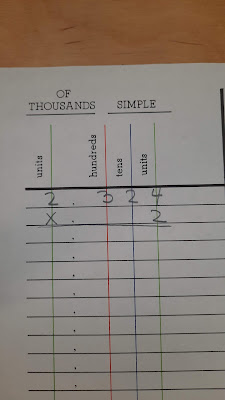
Let's solve a static (no exchanging) multiplication equation.  

2,324

x     2


Begin by sliding the quantities of the multiplicand by the multiplier.  Slide four unit beads to the right one time and then two times.  How many units do we have in total?  Write 8 on the Small Bead Frame paper. 

Sliding four beads to the right once and then twice.


Four taken two times equals eight.  

Do the same for the tens, hundreds and thousands.


The product of the equation - 4,648 - is on the right.


The product is 4,648.


Multiplication ~ Dynamic

Let's solve a dynamic multiplication equation.  Dynamic multiplication equations involve exchanging.


2,394

x     2


Begin by sliding the quantities of the multiplicand by the multiplier.  Slide 4 unit beads to the right one time and then two times.  How many units do we have in total?  Write 8 on the Small Bead Frame paper.


Four taken two times equals eight.

Continue with the tens.  Slide 9 ten beads to the right one time.  


Nine beads taken one time.

Slide 9 ten beads to the right a second time.  There are not enough beads.  Slide the final bead over.  That makes 10 beads.  10 ten beads make one hundred. 


Ten ten beads make one hundred.


Exchange the 10 ten beads by sliding 1 hundred bead to the right.  Slide all 10 ten beads to the left.


Exchange the ten ten beads for one hundred.  Slide one red
hundred bead to the right.  Slide the ten ten beads to the left.

Continue sliding the ten beads to the right until you have slid 9 over in total don't forget one was already slid over before exchanging).  How many tens do we have in total?  Write 8 on the Small Bead Frame paper.


Nine tens taken two times. 

Continue with the hundreds and thousands.  Slide 3 hundred beads over one time and then two times.  How many hundreds do we have in total?  Write 7 on your Small Bead Frame paper.  Slide 2 thousand beads over one time and then two times.  How many thousands do we have in total?  Write 4 on your Small Bead Frame paper.


The product is 4,788 (on the right).

The product is 4,788.


Note:  This material is introduced to children at 5 1/2 + in a Montessori program (SK - grade 1).  Numbers to the thousands are introduced to children in grade 4 of the Ontario Math Curriculum.  Multiplication of the times tables up to 7 is expected by the end of grade 3 of the Ontario Math Curriculum.

Friday, 16 July 2021

Math Materials ~ The Small Bead Frame ~ Operations ~ Subtraction

*The second of three blog posts about the Montessori Small Bead Frame.

The Small Bead Frame is an arithmetic material which helps a child move toward an abstract understanding of mathematical operations.  Addition, subtraction and multiplication equations are solved using this material.  


The Small Bead Frame

The Small Bead Frame is introduced at either the end of the Montessori casa program (ages 3 to 6 years) or at the beginning of the Montessori lower elementary program (ages 6 to 9 years).  Work with the Golden Beads Decimal System material 

Solving an Addition Equation with the Golden Bead Decimal Material

and the Stamp Game precede this work.


Solving an Addition Equation with the Stamp Game


How is the Small Bead Frame used to solve subtraction equations?

Subtraction - Static

Let's solve a static (no borrowing) subtraction equation.  


4,693 - 3,251 =


Form the minuend by sliding 3 unit beads, 9 ten beads, 6 hundred beads and 4 thousand beads to the right.


The minuend - 4,693 - is on the right of the Small Bead Frame.

Have the child subtract the subtrahend by sliding the beads to the left.  Slide 1 unit bead to the left.  What is the difference?  Write 2 on the Small Bead Frame paper.  Do the same for the tens, hundreds and thousands.


The difference of the equation - 1,442 - is on the right.


The difference is on the right.  The difference is 1,442.

4,693 - 3,251 = 1,442


Subtraction - Dynamic

Let's solve a dynamic subtraction equation.  Dynamic subtraction equations involve borrowing.  

7,963 - 3,428 =


Form the minuend by sliding 3 unit beads, 6 ten beads, 9 hundred beads and 7 thousand beads to the right.


The minuend - 7,963 - is on the right.

Subtract the subtrahend by sliding the beads to the left.  For the units, begin sliding the unit beads to the left.  We have 3 unit beads and must subtract 8.  Slide the 3 unit beads to the left. 

Three unit beads have been slid over to the left.  We will borrow one ten
by sliding a ten bead from the right to the left.  This will give us ten units
which will be slid to the right.  Continue subtracting.

We need more unit beads.  Where can we find them?  We can borrow 1 ten bead from the tens row by sliding it over to the left.  Slide the ten fresh units over to the right and continue subtracting the minuend.  Your answer is 5 unit beads.  Write the answer on the Small Bead Frame paper.


Continue subtracting the subtrahend.


Continue sliding the beads of the subtrahend to the left.


The difference is 4,535 (on the right).

The difference is on the right.  The difference is 4,535.

7,963 - 3,428 = 4.535


A Blog Post explaining multiplication with the Small Bead Frame will follow.


Note:  This material is introduced to children at 5 1/2 + in a Montessori program (SK - grade 1).  Numbers to the thousands are introduced to children in grade 4 of the Ontario Math Curriculum.  The addition and subtraction of numbers to 1000 is expected by the end of grade 3 of the Ontario Math Curriculum.