Showing posts with label Culture. Show all posts

Thursday, 23 December 2021

Tombola ~ An Italian Christmas Eve Tradition

This month the children at our little yellow school have been experiencing holiday traditions from around the world.  A game my extended Italian family and I looked forward to playing every Christmas was Tombola. 

My Family's Much Loved Super Tombola Game (circa the mid-1980s)

Playing Tombola on La Vigilia Di Natale (Christmas Eve) is a must for Italians living in Italy and around the world.   As Maria Montessori was Italian, Tombola was most likely part of her family's Christmas celebrations.  

Dr. Montessori


Tombola is a game similar to Bingo.  It consists of 'il cartellone' (the caller's board featuring the numbers from 1 to 90), 'le cartelle' (cards with 15 numbers each), and a fabric sack containing 90 'pedine' (wooden tokens). 

Le Cartelle - The Cards

Tombola was much more than just a game.  It was a holiday tradition that brought our entire family, young and old, together.


Once the meal of homemade meatless lasagna and the Feast of the Seven Fishes (seven separate seafood dishes!) was over, the table was cleared and the Tombola game came out.  Each player paid for a card, 5 cents, which was put into the pot.   Our family usually played for all 15 numbers on the card with the winner taking all.  As the oldest grandchild, I had the privilege of being the number caller.

This year, I introduced the children at our little yellow school to Tombola (minus the gambling).  Each child chose 'una cartella' (a card) and opened all the plastic windows.  A window is closed when a number is called.  Our youngest students had such fun opening and closing the windows, regardless of the numbers that were being called.


Instead of designating one person as the caller, the graduates shared the number calling duties. 


It is important to shake the sack to 'wake up' the numbers.


Shaking the Sack

The children loved playing Tombola!  It was wonderful to see older children helping younger ones, just as older family members would help younger ones during our family Tombola games.  This is also the culture of an authentic Montessori classroom, with children of three year age spans learning and working together.


Most of all, it was lovely to witness the magic of Tombola bringing smiles to the faces of all who play it.

                       Buon Natale - Merry Christmas

Thursday, 14 January 2021

It's Winter!

The children at our little yellow school take great delight in exploring the natural world.  In our little corner of the world, we are so fortunate to experience the four seasons. 


The Seasons/Les Saisons


As Fall changes to Winter, many things are changing all around us.  Let's discover them!


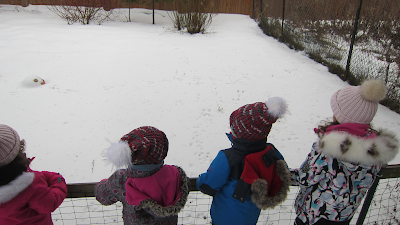
For the children, winter means one thing - SNOW!  As the temperature dipped, we were rewarded with a bounty of the most amazing and beautiful snow!


Beautiful Snow!

How fun it is to work together with our friends to make snow friends!


The little animal friends that frequent our school property have prepared for winter in different ways.  Some have migrated to warmer climates.


A monarch butterfly in our butterfly garden.


Others have worked hard during the fall and have settled in for a long winter nap.


A Hibernation Craft


Some of our little friends have stayed with us and adapted to the new season.  While we don't always see them, they leave signs of their activity behind.


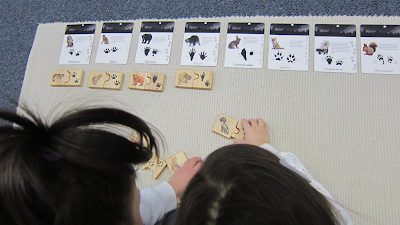
Animal Tracks


So many animal tracks!


More Tracks

One of our students brought in a photo of animal tracks he found in his backyard.  Who made those tracks?


Who made these tracks?

These are fox tracks!

Life size deer tracks.

Discovering Animal Tracks


For those animals that choose to stay here for the winter, food can be difficult to find.  We made some heart-shaped bird feeders to help our little bird friends.


Heart-Shaped Bird Feeders


Welcome Winter!  We're glad you're here!


Winter is not a season,

it's a celebration!


~ Anamika Mishra


Monday, 13 April 2020

Spring Science ~ Growing Seeds in A Jar

While we are all at home, we invited everyone to join us in a spring experiment.  Have you ever wondered what happens to a seed when you plant it in the ground?  Let's find out how seeds grow!

For this experiment, you will need a few simple things that can be found around the house.

Materials

- a clean jar
- paper towels
- dried beans  (You may wish to soak your beans.)
- water


Our Materials

Steps:

1.  Fill the jar with paper towels.


The Jar


2.  Add water to the jar taking care not to flood it.

3.  Push some bean seeds down the sides of the jar.  Ensure
     that they are visible and supported by the paper towels.

Adding Beans to the Jar

4.  Place the jar in a sunny spot.


Observations:

What happened to the bean seeds?

After a few days, my bean seeds sprouted roots.  This is called germination. 


My bean seed has begun to sprout.

The roots grew down.  The job of the root is to find food for the growing plant.  Roots also support and anchor the plant to the ground.


The roots are very fine.

The Root


Slowly but surely, the bean seeds began to grow a stem.  The stem grows up toward the light.  It carries water and minerals from the root to the rest of the plant.


The stem begins to emerge.

Can you see the leaves beginning to peep out?

The growing stems.

Can you see the leaves?

The Stem

Over time, the stems became longer and stronger.  The leaves appeared.  Leaves grow out from the stem.  Their job is to make food for the plant.


The Leaves


My bean plants are getting too big for my jar!


My growing bean plants!


I am going to carefully plant them in a pot and take care of them indoors.  When the weather gets warmer, we can (hopefully) plant them in the vegetable garden at school!  That is something wonderful to look forward to!


Inside a seed is the promise of new life.  Here are some great books about seeds that we have at school.

Books about seeds from our school library.


Here is a fun action song about a growing bean.


I'm a Little Bean Action Song


I'm a little bean small and round,
(curl up on the floor)

Bury me deep into the soft, soft ground,
(sung in a very deep voice)

Sprinkle me with water,
(act out watering with a watering can)

Sunshine too,
(make your arms big and round like the sun)

Watch me grow as tall as you!
(stand and stretch up to the sky)

Saturday, 2 November 2019

The Glories of Autumn

At our little yellow school, autumn is one of our favourite seasons.  At this time of the year, our outdoor environment ~ two grassy playgrounds, towering pine trees, flower and vegetable gardens all set on half an acre of land ~ provides us with a treasure trove of autumn experiences.  Here are some of them. 

Monarch Butterfly Life Cycle and Migration

On the first day of school in September, the children were surprised to find jars of chrysalises in the classrooms.   Each day the children watched and waited for the butterflies to emerge.

Observing
Observing
A Monarch Chrysalis
   
A butterfly emerges from the chrysalis.


 We released the butterflies in our butterfly garden.  


The metamorphosis of the monarch butterfly is a miraculous occurrence.  How fortunate for all of us to have witnessed it and assisted in their migration to Mexico.

Life Cycle of a Butterfly Craft

Life Cycle of a Butterfly Book

The Autumn Harvest

Our autumn harvest began with our potato harvest.  The children planted seed potatoes in our vegetable garden last spring.  It was lovely to see the delight on the children's faces as they dug the potatoes out of the ground.  We had a bumper crop!

Examining the Parts of a Potato Plant

Labelling the Parts of a Potato Plant

Life Cycle of a Potato Puzzle

A Potato Plant

Digging Potatoes

Our Harvest

We harvested apples on our trip to the apple orchard.


Picking an Apple

 Back at school, we baked some delicious apple sweetie pies.

Cutting Apples

Filling a Tart Shell
Adding the Topping


Little Apple Sweetie Pies

We had an Apple Taste Test and tasted different varieties of apples - Golden Delicious, Granny Smith and McIntosh.   We picked the McIntosh apples at the farm.


Which one is your favourite?  Our wall graph has the answers.


Apple Taste Test Wall Graph
  
Granny Smith are my favourite.


Deciduous and Coniferous (Evergreen) Trees

During the autumn months, we always enjoy exploring trees.  The children learned the parts of the tree.


Parts of the Tree Booklet

We learned the difference between deciduous and coniferous (evergreen) trees.  Our maple trees are deciduous trees.

Collecting Leaves

Our pine trees are coniferous (evergreen) trees.  Can you believe each of our towering pines began life as a tiny seed?

Reading the book From Seed to Pine Tree .

Those pines are huge!

Looking at our towering pine trees.

There is always so much to discover in our outdoor environments.  The children collected some lovely treasures from our trees.


Our Collection

We worked together to sort and classify our finds.


Bark
 
Branches
 
Leaves

Needles
 
Seeds

Our Animal Friends

Our animal friends are preparing for the winter.  The little squirrels are knocking down pine cones from our coniferous trees and storing them for the winter.  We found one of their hiding spots!

The squirrel is hiding pine cones in our 'snag'.

Pumpkins

We learned about the life cycle of a pumpkin and the parts of a pumpkin.


The Parts of a Pumpkin
 
The Parts of a Pumpkin


The Parts of a Pumpkin

Hollowing a Pumpkin

Our open outdoor classroom also encourages gross motor skills, observation, and sorting activities.  The natural environment enables us to flutter with the butterflies, watch an earthworm wiggle, hop with the frogs, collect twigs, pebbles and pine cones all the while listening to the sounds of the birds.  We are never happier than when we are basking in the glow of nature's wonder.

Why is a natural outdoor environment so important in Montessori education?  Since the beginning of her work over one hundred years ago, a basic tenent of Montessori's psychology and curriculum for children is the universal need for attachment to nature and the subsequent personality integration that evolves from outdoor activity.  Dr. Montessori believed that Montessori education is not just what happens inside.  She placed a heavy emphasis on nature and the outdoor environment.  The outdoor environment should be an extension of the indoor environment providing children with real experiences in nature.  Our little yellow school could not provide a complete Montessori education without our natural and expansive outdoor environment.  It is invaluable.
There must be provision for the child to have contact with nature; to understand and appreciate the order, the harmony and the beauty in nature.

~ Maria Montessori