Saturday, 11 February 2012

A Different Kind of Winter

This winter has not been a typical Canadian winter.  While the parents and teachers at our little yellow school are enjoying the unseasonably warm and snow-free winter, the children are not.  They are longing for snow, snow and more snow!  They want to build snowmen and slide down the hill in the playground. 

Since this isn't a typical winter, most days the children do not believe that they still have to bundle up to go outside.  Our getting ready to go outside routine often goes like this:


A Child:                      Do we need to wear snowpants today?


Mrs. P.:                        Yes.


A Different Child:      Do we need our hats?


Mrs. P.:                          Yes you do.


Yet Another Child:      How about mittens?


Mrs. P.:                          Yes, you need those too.


L., age 5,  recently wrote a story about a little girl who went outside without any winter clothing and was perfectly fine.  Imagine that!  L. tells me that it is a true story.  I am particularly impressed with her use of exclamation marks. 

Here is her story.


One time a girl went outside without a hat and mittens or anything else!  She was not cold!

Tuesday, 7 February 2012

Cheep! Cheep! We're Here! ~ The Eggs Hatch

This morning we arrived at school to find three tired, wet and newly hatched chicks in the incubator.


The children (parents and teachers) were so excited to see the baby chicks!  By lunch time we had five chicks.


After recess we were surprised to find another wet little chick that had just hatched.  That makes six.


Here is a little chick trying to get some much deserved rest.  Hatching is hard work!


At the end of the day a group of children, parents and teachers were awed to witness a little chick hatching out of its egg. Here is the wing.


Here is the head. 


By the end of the day we had nine cute little chicks and more eggs with cracks.  We can't wait to see what tomorrow brings!

Tuesday, 31 January 2012

An Incubator Full of Eggs ~ Experiencing the Life Cycle of a Chicken

At our little yellow school, our students are fortunate to be able to experience the life cycle of plants in our very own pumpkin patch and vegetable garden.  This academic term, the children will also be experiencing the life cycle of a chicken.

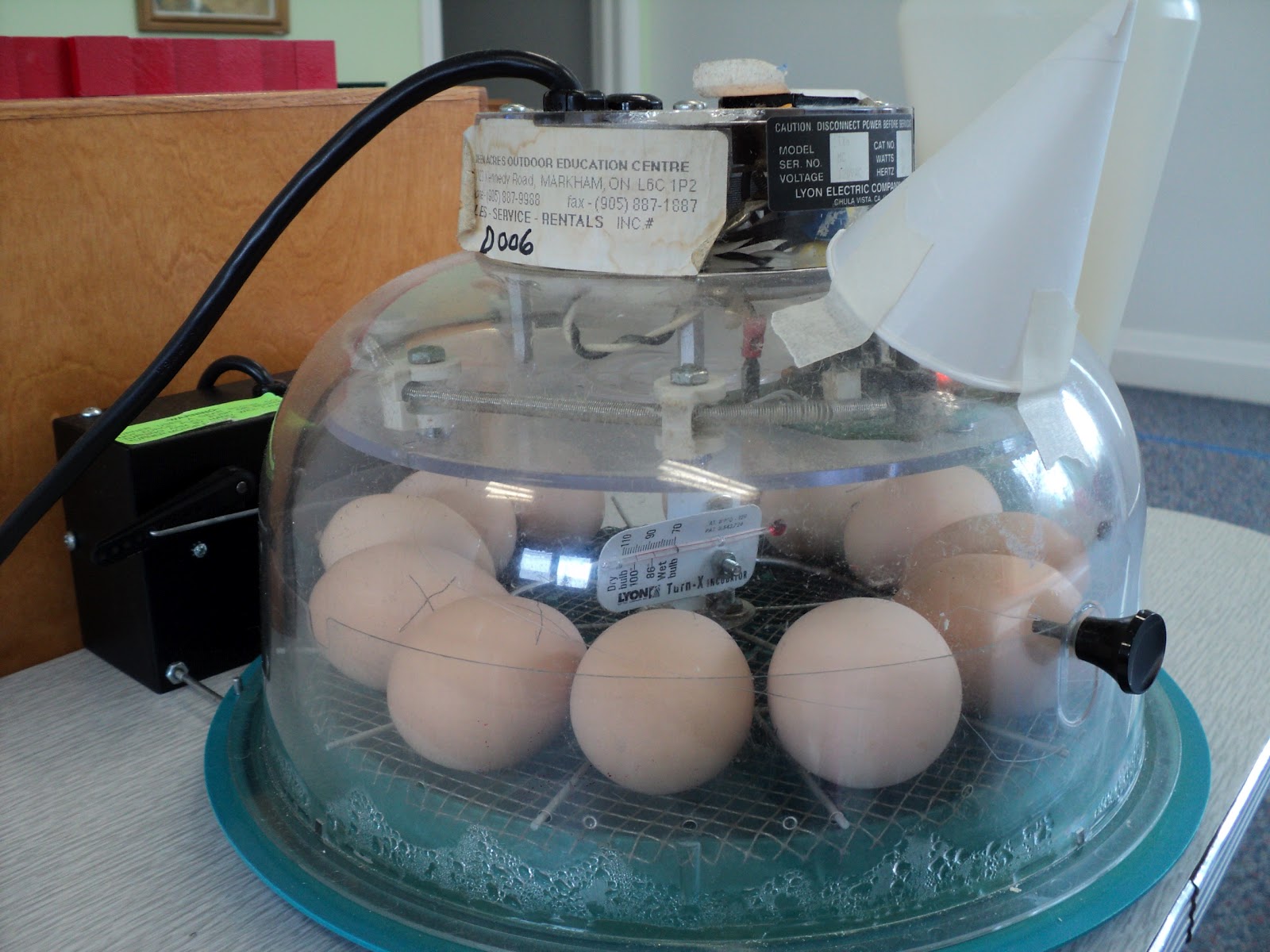
During the last weeks of January, we received an incubator full of chicken eggs from a local farm.


The automatic turner (the black box visible in the picture) turns the eggs five times per day.


The children enjoy monitoring the daily progress of the eggs daily.


The children are keeping track of the days until the eggs hatch on a calendar.


We will stop turning the eggs on February 5.  The eggs are set to hatch during the week of February 6.  We will post pictures of the baby chicks when they hatch.

Saturday, 28 January 2012

Gung Hay Fat Choy ~ A Chinese New Year Presentation by One of Our Students and Her Siblings


Earlier this month, E.'s family asked if E. and her siblings could come in to school and do a Chinese New Year presentation for the children.  We were absolutely thrilled by this and said yes immediately!  Parents had come in to do presentations for us, but never children.  This would be a very special treat indeed!

E. is 4 1/2, B. is 7 and J. is 10.  All have attended Montessori schools. B. and J. wrote the presentation and we were given daily updates as to how things were going as they busily practiced it each night at home.  As the day approached, E. was so excited and so were her classmates.

Here are some highlights of the informative and delightful presentation that kept us all mesmerized.


J. and B. are introducing themselves and telling the children a little about Chinese New Year.


J. is reading a book about Chinese New Year to the children.


E. joins the presentation to wake up the sleeping lion (her brother B.) while J. plays the drums.  They did not bring in the actual drum as it would have been too loud for the children.  J. played her program on padded stools.


These pictures show B.,  the lion, dancing.


E. feeds the lion some lettuce.


Here B. and J. demonstrate Shaolin Wushu Kung Fu, an artform that is over a millenium old.


E. hands out lucky money envelopes to all of the children at school.


We were all so impressed by the flow of the presentation and in J.'s and B.'s ability to keep the attention of so many children. It was a lovely presentation and one we won't soon forget.

Friday, 23 December 2011

Happy Holidays!

So often, the most important things in a child's life are not the big events but the accumulation of small details.

Here are some of the small details that brought joy to our December days.


G.'s & L.'s dad came in to school to speak to us about Christmas.


K. brought in Christmas cookies for the whole school to decorate.


Here are some of the decorated cookies. 


M.'s and E.'s mom came in to speak to us about Hanukkah.  Here M. is showing us her personal menorah.


M.'s and E.'s mom shared many Hanukkah songs with us. The children are singing the Dreidel song and spinning like dreidels.


We hear Santa's jingle bells!  Santa has parked his sleigh and reindeer in the forest.  The children are looking out the window and are able to catch a glimpse of the reindeer!  The teachers were not quite as fortunate.


We are so grateful that Santa was able to visit us during our holiday party.  Here the children are asking Santa questions.  Santa was so happy to hear all the songs we sung to him.


From our little corner of the world to yours, wishing everyone a Merry Christmas, Happy Hanukkah and a very happy holiday season!


Thursday, 15 December 2011

Catching Up With Our Three Year Olds and Our Youngest Students ~ Part 2

Here is Part 2 of our blog about the Montessori work our youngest students are doing.


Sandpaper Numbers

The Sandpaper Numbers are similar to the Sandpaper Letters described in Part 1 of our blog about the work of our youngest students.  The Sandpaper Numbers consist of ten thin boards on each of which is glued a number from '0' to '9' cut from smooth sandpaper.  The purpose of this material is to introduce the symbols for the quantities '0' to '9'.

In the photograph below, L. has been introduced to the numbers '3', '4' and '5'. 


L. is feeling each number using a light and continuous touch while saying the name of each number.


The Spindle Box

The Spindle Box is a tray divided into sections labelled '0' through '9'.  A separate box contains forty-five wooden spindles.

The purpose of this material is to show that numbers can represent a collection of single objects,  to experience the quantity of 'zero' and to show the child that '0' to '9' are all the symbols needed for arithmetic.  In order to work with this material the child must be able to identify all of the Sandpaper Numbers.

In the photograph below, E. is setting out all of the spindles below the Spindle Box.


In the following photographs E. is counting the spindles and placing them in the appropriate partitioned space.


Weekly Craft

Each week the children participate in our weekly craft.  In the following photographs, N. and L. are making a reindeer.


Printing in the Montessori Classroom

The indirect preparation for printing begins with the early Practical Life and Sensorial exercises.  The early exercises refine and strengthen the child's fine motor skills and the three finger grip necessary for holding a pencil.

Cutting strips with scissors is an example of a Practical Life exercise which focuses on manipulative skills and prepares the child's hand for printing.  In the following photographs A. is so engrossed in her work with the scissors that she is oblivious to everything around her.  


A.'s work with the Practical Life activities has refined her fine motor skills and has led to tracing work and practicing letters on the unlined chalkboard.


Printing Individual Letters on The Unlined Chalkboard

The unlined chalkboard is used with the Sandpaper Letters and the Sandpaper Numbers.  The purposed of this material is to assist the child with the proper formation of letters and numbers.  When a child is able to form their letters correctly on the unlined chalkboard, they are introduced to printing their letters using a pencil and unlined paper.

In the following photographs, O. is practicing printing her name.


Printing On Lined Paper

 When a child is able to form their letters correctly on unlined paper, they are then introduced to printing their letters on lined paper.

In the following photographs, R. is practicing her letters in her printing book.