Friday, 12 September 2014

It's Harvest Time!


On Monday, the children spent time in our back garden harvesting our potato crop.  We planted seed potatoes in May.  All summer, the potato plants grew above the ground while the potatoes grew beneath the ground.    


Potatoes peeking out from the ground.

The children were so excited to be in the garden.  There were squeals of delight as they dug the earth and found potatoes!


I found one!

Some children with their bags of potatoes.

Happy In The Garden

Each child took home potatoes to share with their families. The potatoes were so fresh, tender and delicious!  Everyone was eager to share what they did with their potatoes. 


Here are some pictures of E. and L. preparing their potatoes for dinner.


E. Peeling The Potatoes.


L. Mashing the Potatoes


Yum!

Thank you to E.'s and L.'s mom for sharing their potato cooking adventure.  We all agreed that the potatoes were the best we had ever tasted!

Tuesday, 9 September 2014

Happy Birthday Madeline!


In an old house in Paris that was covered in vines
Lived twelve little girls in two straight lines.


The first page of Madeline's Rescue.

So begins Ludwig Bemelman's tale of Madeline, a spirited red-headed little Parisian girl.  The first book in the series was published in 1939.  On September 5, Madeline turned 75. 

The book that began it all.


At our little school, Madeline's stories are perennial favourites. There are a handful of books that we simply must have additional copies of should anything happen to one of them.  The Madeline books are among those. 


To celebrate Madeline's birthday, we read the original book and talked about her.  We had a lovely snack of croissants and chocolate milk.  Very French!  We had hoped to have hot chocolate but the day was far too warm.


Why does Madeline continue to be so appealing to both boys and girls so many years later?  She is small, yet she is fearless!  When reading the books, the children are amazed that Madeline is not afraid of very much, not even the tiger in the zoo!

To the tiger in the zoo Madeline just said "Pooh pooh."

Thank you Madeline for continuing to show us that even if we are small, we can still be brave.


Friday, 15 August 2014

Tadpoles in the Classroom

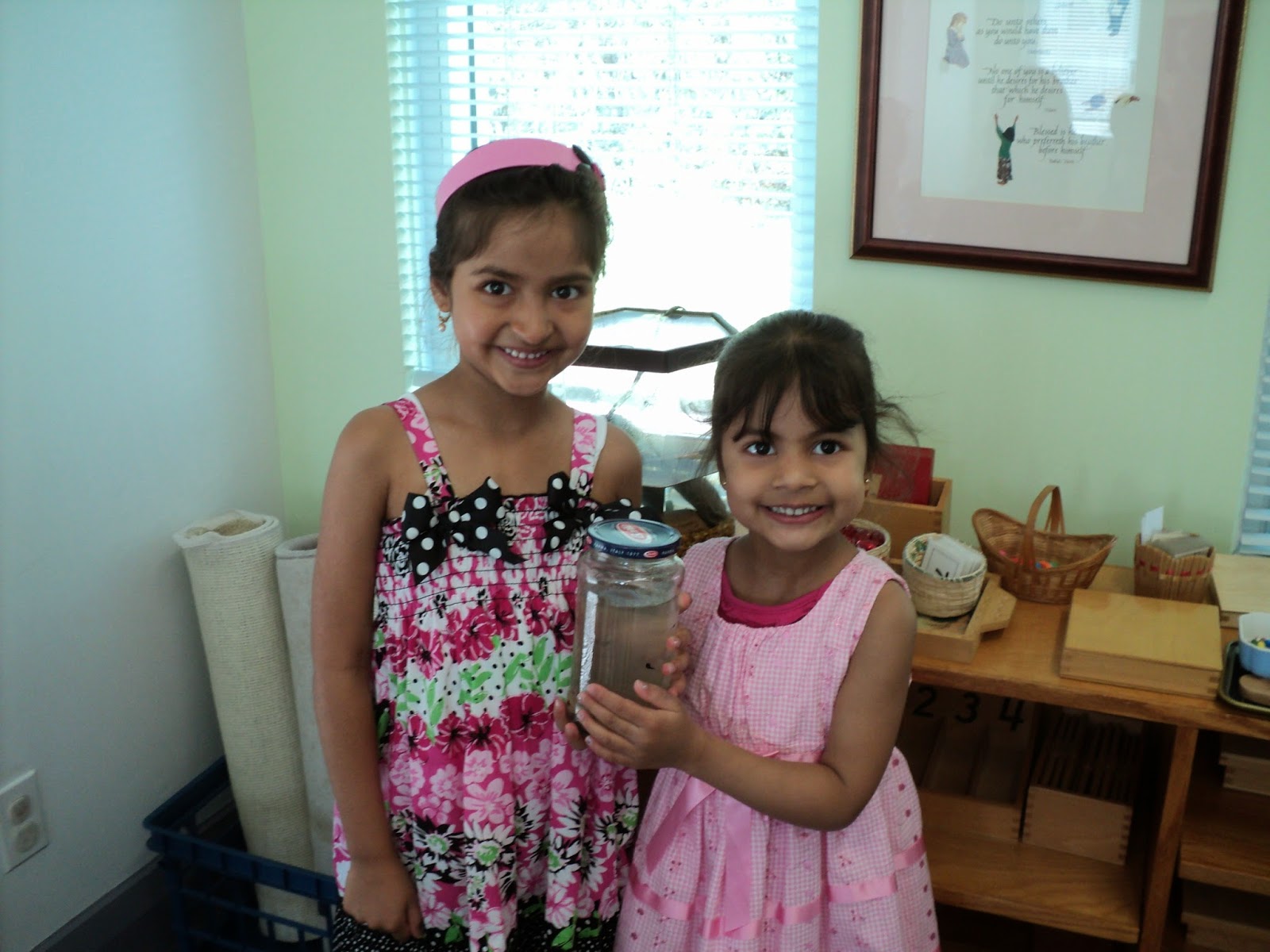
In the spring, we put a little request in our school newsletter.  If anyone comes across tadpoles, could they please bring some in to the school.  Two of our families found some!

Thank you to D. for bringing in tadpoles for the upstairs class.


Thank you to sisters R. and E. for bringing in tadpoles for the downstairs class.


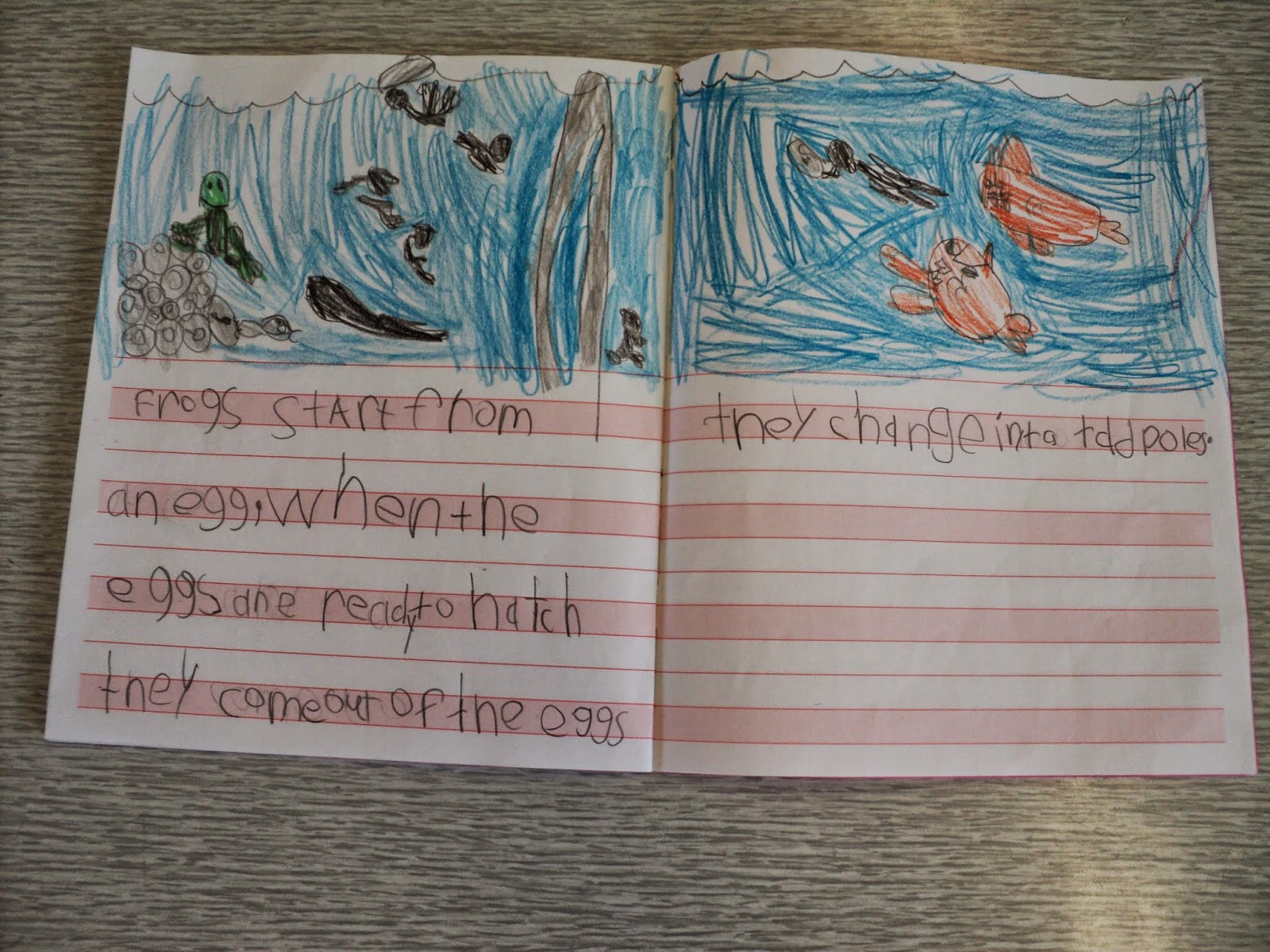
R. wrote a story about the tadpoles she brought to school. (You can click on the images to make them larger.)


The tadpoles were a huge source of conversation and many stories were written about them.

A story written with the Story Alphabet

The Finished Story


Do you know why the children were so fascinated by the tadpoles?  S.'s story offers an explanation.

When one of the tadpoles die, another one eats it.

Yes, we did see many tadpoles eating one another.  Truly fascinating. Unfortunately, the school year ended before we were able to see the tadpoles change into froglets.  The very long winter delayed their life cycle.  We released the tadpoles into nearby ponds.  We truly enjoyed having the tadpoles in our classrooms. 

Saturday, 9 August 2014

Out of This World ~ Our Study of the Solar System

During the Spring term, we spent a number of weeks learning about our Solar System and outer space.  Children and teachers were both fascinated by this subject and we all learned quite a lot.

Our study began during Circle Time with the story of The Big Bang.  Every few days we would read a book about a different planet.  We have individual planets in the classrooms and the older children made their own planet books.  The children were so distressed that Pluto is now classified as a dwarf planet.  We sing a song about the planets and had to add a verse that says "We feel so sorry for little Pluto."  Pluto captured everyone's imagination.

The children were so passionate about their favourite planets that we created a wall graph.  It answered the question "Which Planet Is Your Favourite?"


Which Planet Is Your Favourite?
  

Each child wrote their name on a piece of paper and placed it beneath their favourite planet.


When everyone had placed their name under a planet, we discussed the results.  Which planet do we like the most? Which planet do we like the least?  How many people like (name a certain planet)?  The children found the results fascinating and the graph was a source of discussion for many days.


Examining The Results

For craft, each child made their own planet.


The highlight of our space study was the contents of this bag. Can you guess what's in the bag?


Real astronaut food, freeze dried ice cream, was in the bag!


The NASA calendar was given to us by N.'s family.  When N.'s older sisters were at our school, they brought back calendars for the school when they visited the Kennedy Space Center. N. was just a baby at that time.


N. With A NASA Calendar

This is what the ice cream looked like.

Astronaut Ice Cream


We all tried some of each.  You have to use the saliva in your mouth to moisten the ice cream.


On another day, we had real Earth ice cream sprinkled with freeze dried ice cream dots.


Freeze Dried Ice Cream Dots

It was yummy!


Learning about the Solar System was out of this world!

Tuesday, 29 July 2014

In The Classrooms With....Our Three Year Olds ~ Part 2

This is the last post in a series of posts about the work of our students in our classrooms.  This post is the second part of a post about the work of our three year olds.  The children in these photographs, which were taken during the months of January to June, are in their first year of the Montessori casa (preschool) three year curriculum.  These children will all turn four in this calendar year and are considered preschoolers.


Taking Home A Reading Book
In the Montessori Language curriculum, children are not taught the names of the letters of the alphabet.  They are taught the first sound that each letter makes with the Sandpaper Letters.


The Sandpaper Letters


This material helps the child associate the sounds of speech with their written symbol.  Lessons are given individually and each child works through the letters at their own pace.  When a child knows all of his/her sounds, s/he begins work with the Large Moveable Alphabet and Pink Object Boxes as described in previous posts.


The Large Moveable Alphabet

The Pink, Blue and Green Object Boxes

Spelling Words


Independent reading begins to develop at this time. When a child is able to read individual words, they are given a reading book to take home.


This is quite a momentous occasion in our classrooms and all of the children are truly happy and proud of their classmate. It is always lovely to see fellow classmates congratulate the new reader on his/her accomplishment.  Of course the child with the reading book couldn't be happier.


Introduction to Teens

In part one of this blog post, two exercises illustrated the young child's introduction to numbers to ten.  Once a child is able to associate quantity and symbol for numbers zero to ten, the decimal system and the teens and tens are introduced concurrently.

In the following photographs, three year old E. is working with the Teens material.  The primary purpose of this material is to associate the names 'eleven' to 'nineteen' with their quantities and symbols. 


E. is taking the bead bars out of the box.

This material consists of nine different bead bars called the Short Bead Stair.  They range in length from one bead to nine beads.  Each bead is a different colour.  It also consists of nine golden ten bead bars.


The Teens Material

E. begins by forming the Short Bead Stair in the shape of a triangle.  The base (the one bead bar) is on the top.


Forming the Short Bead Stair


Forming the Short Bead Stair

Laying out the Ten-Bead Bars


The child then sets out one ten-bead bar and sets out the one bead to the right of it to make eleven.  The child continues with twelve and thirteen.  The teacher gives the child a three period lesson on these names.  If the child shows interest, three more numbers can be introduced.  If not, the numbers can be introduced at another time.  


Birthday Circle

Birthdays are an important part of a young child's life and they are celebrated in the Montessori classroom.  All of the child's classmates come together to celebrate the life of the birthday child.  A stool and candle are placed in the middle of the circle.  The candle represents the sun.  The months of the year are set out around the sun.  The birthday child holds the globe.  His/her teacher tells the story of the child's life while the child walks around the sun the same number of years they have been on the Earth. 


Walking Around the Sun


The birthday child receives birthday wishes from each classmate. These wishes are so adorable!  At the end of the circle, the children sing 'Happy Birthday'.  The birthday child blows out the candle.


Blowing Out The Candle


The Pink Tower

The Pink Tower is part of the Sensorial area of the Montessori classroom.  This area of the classroom helps to develop the child's senses.  The Pink Tower is an early Sensorial exercise.  The main purpose of this material is to help develop the child's visual discrimination of differences in three dimensions.  It also helps in the development of fine muscular coordination.

This material consists of ten pink wooden cubes varying in size and differing equally in all dimensions by one centimetre.  The child is asked to bring The Pink Tower to a mat.  Each cube is taken individually and placed randomly on a mat.  The teacher then begins to build the tower vertically beginning with the largest cube.  Once the tower has been built, the child and teacher examine the tower from all sides. The tower is dismantled cube by cube.  The child is then offered a turn.


N. Is building The Pink Tower


 The Button Frame

The Button Frame is part of the Practical Life area of the Montessori classroom.  These activities are the first activities a child is introduced to when they begin their Montessori education. These activities - pouring, sweeping, hanging clothes on a hook, setting out a place setting and many more - allow the child to try doing the things they see the adults around them doing.  These activities fall into three categories.  The Dressing Frames fall into the category of Care of Oneself or Self Development.

The purpose of the Button Frame is to help the child develop co-ordination and independence.


Working With The Button Frame


Our Youngest Student

Our youngest student began with us in January and turned three in this calendar year.  She is a little camera shy. When she sees the camera she says "No thank you."  We did manage to snap some photos of her.


Making a Snowman


Baking Cookies on Pajama Day

Working with the Spindle Boxes


I hope you have enjoyed reading about the work the children are doing in the classrooms.  They are consistently busy and we are so proud of their efforts and their accomplishments.