Wednesday, 16 February 2022

Let's Celebrate! ~ Celebrations in the Montessori Classroom

There are many different opinions on whether or not to celebrate holidays in the Montessori classroom.  Some schools choose not to celebrate anything except the birthdays of their students.  Whether we choose to celebrate holidays in the classroom or not, they still exist in the world.  In my nearly 30 years of teaching, I have always celebrated holidays with the children in my classrooms and at our little yellow school.   The holidays we have celebrated are inclusive of the cultures and religions of the children and families in our school community.   

At our little yellow school, the celebration of a holiday is not highlighted on one day with no connection to anything else.  Rather, activities are introduced gradually across the curriculum in the weeks leading up to the celebration.  The following are some examples.

The Practical Life shelves reflect the colours and theme of the celebration.

Valentine Tonging Work

Lunar New Year Tonging with Chopsticks

Spooning Pumpkin Seed 'Ghosts"


Opening Easter Eggs with Surprises!

Preparing Pumpkin Seeds for Roasting

Peg Christmas Tree

The Language Shelves and Circle Time incorporate stories, poems and songs.

Melting Like a Menorah Candle

A Halloween Rhyme

Learning About Diwali

 
A Valentine Book

Playing Tombola (An Italian Christmas Eve Tradition)

Spinning a Dreidel

Decorating the Christmas Tree

Arithmetic activities incorporate seasonal items such as seasonal counters.


Halloween Ghost Counters

Valentine Heart Estimating Activity

Art activities change to reflect the holiday.

Valentine Hearts

Lunar New Year Tigers
 

Reindeer Craft

Diwali Lamps


The Culture Shelves have items and photos associated with the holiday.


Lunar New Year Items


Hanukkah Items

A Visit from Santa Claus


A Visit from St. Nicholas on December 6 (Treats left in our shoes!)


The loveliest thing about introducing holidays and celebrations gradually is that it does not interfere with classroom routines.  Children thrive on the routine and the predictability of their school days.  By incorporating the holiday into the classroom routine, the children are able to learn about the holiday at their own pace while expanding their minds, their worlds, but most of all their hearts.  


"As different as we are from one another, as unique as each one of us is, we are much more the same than we are different.  That may be the most essential message of all, as we help our children grow toward being caring, compassionate, and charitable adults."

~ Mr. Fred Rogers (Mr. Rogers Neighborhood)


Sunday, 9 January 2022

Math Materials ~ The Small Bead Frame ~ Operations ~ Multiplication

 *The third of three blog posts about the Montessori Small Bead Frame.

The Small Bead Frame is an arithmetic material which helps a child move toward an abstract understanding of mathematical operations.  Addition, subtraction and multiplication equations are solved using this material.  

The Small Bead Frame

The Small Bead Frame is introduced at either the end of the Montessori casa program (ages 3 to 6 years) or at the beginning of the Montessori lower elementary program (ages 6 to 9 years).  Work with the Golden Beads Decimal System material


The Golden Bead Decimal Material

and the Stamp Game precedes this work.


Solving an Addition Equation with the Stamp Game

How is the Small Bead Frame used to solve multiplication equations? 

Before I get to how this material is used for multiplication, it is important to discuss the language used.  It differs slightly from more traditional methods.  The language is the key.  Instead of saying multiplication is two times four, we would say that multiplication is a number taken many times.  In this way, we would say two taken four times.


Multiplication - Static

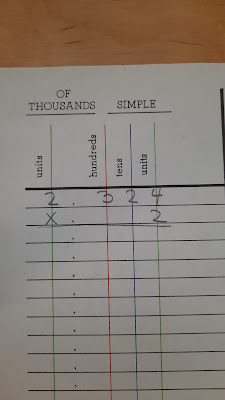
Let's solve a static (no exchanging) multiplication equation.  

2,324

x     2


Begin by sliding the quantities of the multiplicand by the multiplier.  Slide four unit beads to the right one time and then two times.  How many units do we have in total?  Write 8 on the Small Bead Frame paper. 

Sliding four beads to the right once and then twice.


Four taken two times equals eight.  

Do the same for the tens, hundreds and thousands.


The product of the equation - 4,648 - is on the right.


The product is 4,648.


Multiplication ~ Dynamic

Let's solve a dynamic multiplication equation.  Dynamic multiplication equations involve exchanging.


2,394

x     2


Begin by sliding the quantities of the multiplicand by the multiplier.  Slide 4 unit beads to the right one time and then two times.  How many units do we have in total?  Write 8 on the Small Bead Frame paper.


Four taken two times equals eight.

Continue with the tens.  Slide 9 ten beads to the right one time.  


Nine beads taken one time.

Slide 9 ten beads to the right a second time.  There are not enough beads.  Slide the final bead over.  That makes 10 beads.  10 ten beads make one hundred. 


Ten ten beads make one hundred.


Exchange the 10 ten beads by sliding 1 hundred bead to the right.  Slide all 10 ten beads to the left.


Exchange the ten ten beads for one hundred.  Slide one red
hundred bead to the right.  Slide the ten ten beads to the left.

Continue sliding the ten beads to the right until you have slid 9 over in total don't forget one was already slid over before exchanging).  How many tens do we have in total?  Write 8 on the Small Bead Frame paper.


Nine tens taken two times. 

Continue with the hundreds and thousands.  Slide 3 hundred beads over one time and then two times.  How many hundreds do we have in total?  Write 7 on your Small Bead Frame paper.  Slide 2 thousand beads over one time and then two times.  How many thousands do we have in total?  Write 4 on your Small Bead Frame paper.


The product is 4,788 (on the right).

The product is 4,788.


Note:  This material is introduced to children at 5 1/2 + in a Montessori program (SK - grade 1).  Numbers to the thousands are introduced to children in grade 4 of the Ontario Math Curriculum.  Multiplication of the times tables up to 7 is expected by the end of grade 3 of the Ontario Math Curriculum.

Thursday, 23 December 2021

Tombola ~ An Italian Christmas Eve Tradition

This month the children at our little yellow school have been experiencing holiday traditions from around the world.  A game my extended Italian family and I looked forward to playing every Christmas was Tombola. 

My Family's Much Loved Super Tombola Game (circa the mid-1980s)

Playing Tombola on La Vigilia Di Natale (Christmas Eve) is a must for Italians living in Italy and around the world.   As Maria Montessori was Italian, Tombola was most likely part of her family's Christmas celebrations.  

Dr. Montessori


Tombola is a game similar to Bingo.  It consists of 'il cartellone' (the caller's board featuring the numbers from 1 to 90), 'le cartelle' (cards with 15 numbers each), and a fabric sack containing 90 'pedine' (wooden tokens). 

Le Cartelle - The Cards

Tombola was much more than just a game.  It was a holiday tradition that brought our entire family, young and old, together.


Once the meal of homemade meatless lasagna and the Feast of the Seven Fishes (seven separate seafood dishes!) was over, the table was cleared and the Tombola game came out.  Each player paid for a card, 5 cents, which was put into the pot.   Our family usually played for all 15 numbers on the card with the winner taking all.  As the oldest grandchild, I had the privilege of being the number caller.

This year, I introduced the children at our little yellow school to Tombola (minus the gambling).  Each child chose 'una cartella' (a card) and opened all the plastic windows.  A window is closed when a number is called.  Our youngest students had such fun opening and closing the windows, regardless of the numbers that were being called.


Instead of designating one person as the caller, the graduates shared the number calling duties. 


It is important to shake the sack to 'wake up' the numbers.


Shaking the Sack

The children loved playing Tombola!  It was wonderful to see older children helping younger ones, just as older family members would help younger ones during our family Tombola games.  This is also the culture of an authentic Montessori classroom, with children of three year age spans learning and working together.


Most of all, it was lovely to witness the magic of Tombola bringing smiles to the faces of all who play it.

                       Buon Natale - Merry Christmas