Sunday, 6 October 2013

Our Trip to the Apple Orchard

During the last week of September, the children, parents and teachers at our little yellow school visited the apple orchard. We couldn't have asked for a nicer day for our visit.

The morning started off with a bus ride to the orchard.


Boarding the Bus

 Once at the orchard, we all walked down to the barn.


Walking to the Barn
Inside the barn our instructors taught us so much about apples!  We learned about the different kinds of apples, how an apple tree is grafted and the many different foods that are made with apples.


Listening to Our Instructor

Little apple decorations hanging from the ceiling.

Different Kinds of Apples

We had lots of fun in the hayloft!


Back in the barn, we learned about life inside a beehive. The children were very excited to act out the roles of the bees.

Each group had a Queen Bee.  The Queen Bee's role is to stay inside the hive, mate and lay eggs.


A. was the Queen Bee for the full day group.

A. was the Queen Bee for the half day group.

A beehive also consists of worker bees.  Worker bees are female.  They have many jobs.  They tend to the Queen, keep the beehive cool, gather nectar and pollen, supply food for the Queen and the babies and make and produce beeswax.


The worker bees going out to gather nectar and pollen.
The hive also has drones.  Drones are males.  Their job is to mate with the Queen.  They don't collect nectar or pollen. They can't defend the hive because they don't have stingers. 

Here come the drones!

This is part of a real beehive.

Then we boarded the wagon for the trip to the apple orchard.


Next stop, the apple orchard!

Here we are on the wagon.

Once at the apple orchard, we got to pick our own apple. 


An Apple Tree


This is the one.


Three friends enjoying their time in the orchard.


I picked this one!

After the orchard, it was time to board the bus back to our school.  Thank you to all the parents and grandparents who joined us for our trip.  It was a perfect day!

Saturday, 28 September 2013

The Story of the Apple Star

In preparation for our trip to the apple orchard, we spent time in September learning a little more about apples.


On the edge of our property there is an apple tree that we can see from one of our playgrounds.  


One fine September day, both classes of children went for a walk to visit with the tree.


The branches were full of red apples!  We picked a few and brought them back to school to use for craft.  


Did you know that every apple contains a star?  Here is the story of the apple star.


The Story of the Apple Star

Once upon a time, a young apple tree began growing in an orchard.  Each night, she would gaze up into the evening sky and admire all the bright and twinkling stars.  Oh how she wished she had just one of those shining stars of her own!

One night, an orchard fairy came to the tree with a promise to grant the little tree one wish.  Without hesitation, the young apple tree told the fairy of her wish for a star of her own.  The fairy promised that if the apple tree was a good tree and grew to be big and strong and full of red, ripe apples, her wish would be granted.

The apple tree tried her very hardest.  Each sunny day she lifted her branches up to the warm sunshine and each rainy day her roots soaked up the water she needed to grow.  After several seasons, her hard work had paid off and she was one of the biggest trees in the orchard with branches heavy with red, ripe apples.  She waited and waited for the orchard fairy to return so she could show her what she had done and finally granted her wish.

The apple tree was beginning to lose hope when one day the fairy returned at last.  The tree shook her limbs with excitement, showing off her strong branches and all those beautiful apples.  “Look!” she exclaimed.  “I’ve worked so hard and I’ve waited so patiently.  When will I finally be given my wish and one bright star of my own?”

“Oh, my dear tree,” replied the fairy, “Your wish has already been granted.  You now have among your branches not just one, but as many stars as you’d admired in the night sky.”

“But where?” questioned the apple tree.  “All I see on my branches are leaves and these ripe apples!”

The orchard fairy gently answered, “Just peek inside any one of those apples.  There you’ll find a special, secret hidden star.  It’s ready to be discovered by the lucky person who chooses one of the apples you’ve worked so hard to grow!”


(From ComeTogetherKids.com)


For craft we made prints of the stars within the apples.


Here is our apple star book.


Pictures of our morning at the apple orchard will follow later on this week.


Tuesday, 24 September 2013

Preparing for Fall ~ The Mystery of the Falling Pine Cones

As the season moves from summer to autumn, the children at our little yellow school have been observing the changes in the natural world that surrounds us.  We are very fortunate that our little school is located on a half acre of land in the heart of Oak Ridges.  The majority of our land consists of natural space ~ grass, multiple gardens and many, many trees.  Each season provides us with something new to observe and learn in our "outdoor classrooms". 


We have a little red tree squirrel living in our towering pine trees.    
Our little red tree squirrel.


In the late summer and early fall, this little squirrel begins harvesting the pine cones found on the pine trees. 


Green pine cones on our pine trees.


Each day during our outdoor time we find many pine cones underneath the trees.  By the end of the day, the cones are usually gone.


Red squirrels are very territorial and our squirrel will often make clicking noises at us.  This means that our little red squirrel is not happy with us being in his space.

So why is the red squirrel collecting so many cones?  It is because the red squirrel loves to eat the seeds found within the cones.

After a little careful observation, we discovered where the cones are being stored.  At the edge of our property, under the towering pines, we found a huge pile of cones!  These pine cones will provide the red squirrel with nutrients and energy for the long winter ahead.


A pile of pine cones.

  
On the edge of the cache of pine cones.

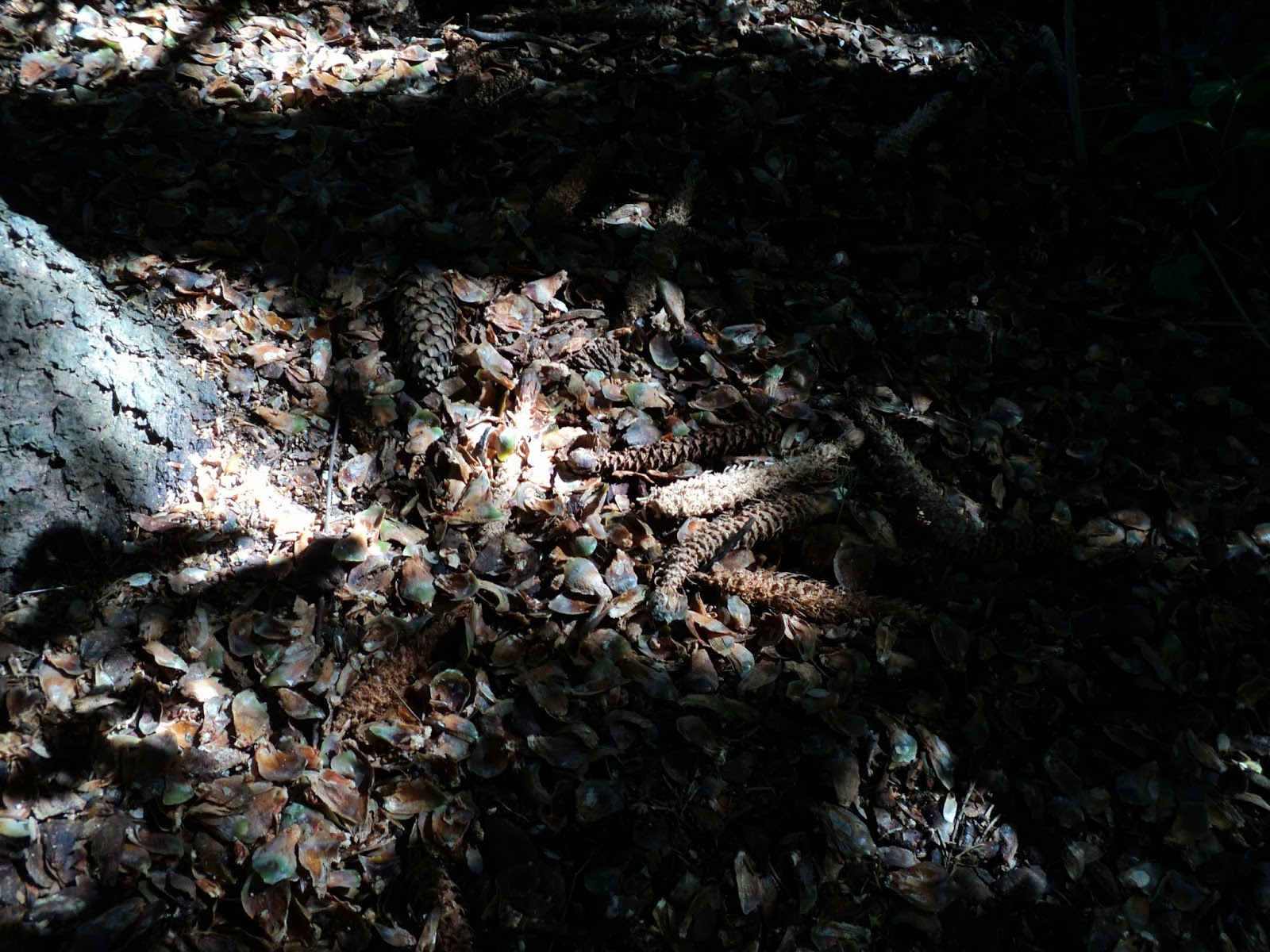
We also found a pile of consumed cones and scales.  This is called a midden.

A pile of consumed cones called a midden.


Examining the cones and the pile of scales.

Finding the cache of cones and the midden was a little like solving a mystery.  We had so much fun!  It is these hands-on experiences in the natural world that instill in all of us a profound respect for living things.


"How often is the soul of man, especially the child, deprived because one does not put him in contact with nature?"

~ Maria Montessori

Saturday, 14 September 2013

From Our School Garden to the Dinner Table

Here are some photographs of I. helping to prepare the potatoes she harvested in our garden at school.  I. helped wash, cut and eat the potatoes.  She watched as the potato rounds were frying.  


Thank you to I.'s mom for sending us the photos.  They are beautiful!

Time for the Harvest ~ Working in Our Garden

Here at our little yellow school, the new school year began just after Labour Day.  One of our traditions is to bring all of our students together to harvest the potato crop.  Depending on the summer weather, this event usually occurs during the first few weeks of September. 

In May, our students planted seed potatoes.  As we are closed for the summer, the plants were lovingly watered and cared for.  When school began, there were signs that it was time for us to harvest.


Our students planting seed potatoes in the Spring.


Mr. V. came to help with the harvesting.  He demonstrated where and how to dig for the potatoes.


Mr. V. starting the digging.  That is our little yellow school way back in the distance.


The new potatoes cling to the roots of the plant.


The children took turns digging in the garden and harvesting the potatoes.


Can you see a red potato peeking out of the soil?

Digging is hard work!
A. holding a potato plant.


Look at what I found!

The children were delighted by the crawling and flying critters that call our garden home.


A ladybug is sitting on R.'s finger.

Here are some of the potatoes that were harvested.  Each of our students took some potatoes home.


This year we tried a little experiment in our garden.  The half day children planted kernels of ornamental corn that we saved from last year's fall decorations.  Guess what?  They grew!


Stalks of ornamental corn growing in our garden.


We hope to harvest some cobs in a few weeks.  We all had a lovely time in our garden.  What a great way to begin our year together!

Wednesday, 14 August 2013

Sensorial Materials - The Pink Tower

The Pink Tower is part of the Sensorial area of the Montessori classroom.  This area of the classroom helps to develop the child's senses.  The Pink Tower is an early Sensorial exercise.  The main purpose of this material is to help develop the child's visual discrimination of differences in three dimensions.  It also helps in the development of fine muscular coordination.


N. is building The Pink Tower

This material consists of ten pink wooden cubes varying in size and differing equally in all dimensions by one centimetre.  The child is asked to bring The Pink Tower to a mat.  Each cube is taken individually and placed randomly on a mat.  The teacher then begins to build the tower vertically beginning with the largest cube.  Once the tower has been built, the child and teacher examine the tower from all sides. The tower is dismantled cube by cube.  The child is then offered a turn.

Friday, 9 August 2013

Itsy Bitsy Spiders ~ Nature in Our Outdoor Classroom

At our little yellow school, we have two large outdoor playgrounds. Both are natural spaces with grass, mature trees and vegetable and flower gardens. The playgrounds are also teeming with nature ~ rabbits, squirrels, chipmunks, a groundhog, various birds, snails, butterflies, ladybugs and grasshoppers frequent our playgrounds.  One winter a woodpecker was a frequent visitor, pecking holes in our pine trees. We have even seen a baby fox! Each season brings changes to our outdoor spaces and provides the children with many opportunities to explore and establish a bond with nature. They are our outdoor classrooms.

One fine June day, the children discovered something they had never seen before. Excited by their find, they came running to their teachers to show them.


Can you guess what they found?


It was an egg sac of spiderlings! The following are pictures of the sac 'exploding' with the spiderlings dispersing away from each other on little silken threads. (If you would like a closer look, click on the individual pictures to enlarge them.)


We did a little research and discovered that these spiderlings were most likely Common Garden Spiders.


Throughout our outdoor time that day, the children continued to observe the hatching spiderlings. Not once did any of them disturb the unfolding of nature. It is the little experiences in nature, such as watching spiderlings hatch, that remind us of just how beautiful and awe inspiring the natural world truly is.